Grain Bin Sealing: Complete Guide for Rusty Bins
Rust eats through metal walls. Air leaks through every seam and rivet. These small gaps create massive problems for grain storage and farm economics.
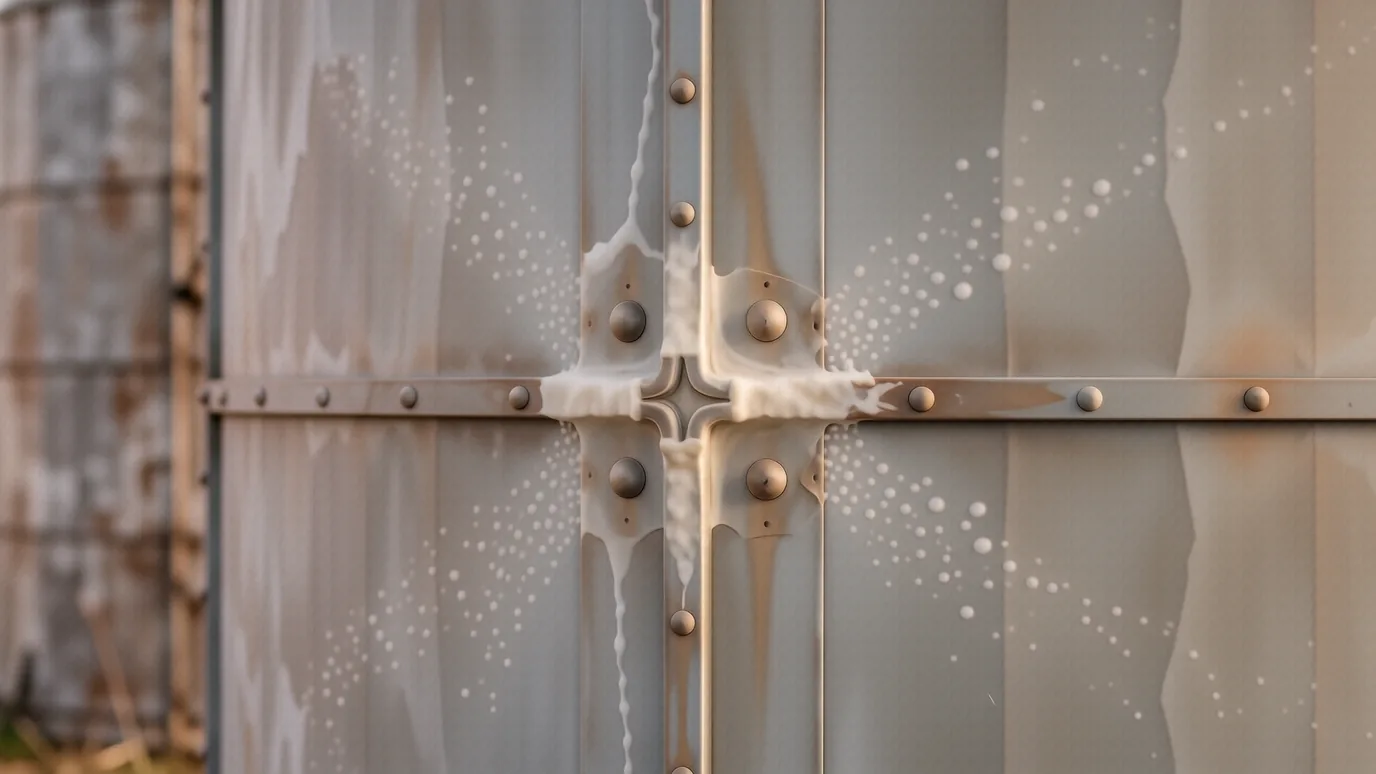
The High Cost of Leaky Grain Bins
Rust eats through metal walls. Air leaks through every seam and rivet. These small gaps create massive problems for grain storage and farm economics. When moisture enters a bin, it triggers spoilage and mold growth.
Leaky bins waste money. You lose heat in winter and dry air in summer because the structure cannot maintain its internal environment. This instability forces your ventilation systems to work harder than necessary.
Why Sealing Matters for Your Operation
Grain storage is about more than just holding corn or soybeans. It involves managing moisture, temperature, and pests. A single rusted hole can invite darkling beetles into your supply.
Biosecurity is a major concern. In the November 2005 University of Georgia newsletter, researchers demonstrated how easily pests penetrate unsealed structures. If insects get in, they destroy your profit margins through damage and contamination.
Energy costs also rise when bins leak. While most people think of climate-controlled poultry houses, grain bins require thermal stability to prevent condensation. Condensation leads to localized heating and rapid spoilage.
Poor temperature control ruins quality. You want consistent conditions throughout the entire pile.
The Challenges of Rusty Metal Structures
Rust creates a moving target for contractors. Traditional sealants often fail because they cannot bond to oxidized surfaces. They peel off after one season.
You face three main hurdles:
- Surface preparation on pitted metal.
- Expanding gaps caused by structural shifting.
- Maintaining a seal during temperature swings.
Standard polyurethane foams are often too light for these jobs. Auburn University testing shows that Ag-Tite products reach a density of ~1.5 lb/ft³, which is twice the density of many competing polyurethane options. This extra mass helps the sealant stay seated against heavy metal walls.
Recommended Products for Grain Bin Sealing
We do not recommend one-size-fits-all solutions. Different leaks require different chemistries. For large-scale structural gaps, AireBarrier Black/White provides a high-performance air barrier.
It yields ~16 board-feet per gallon at a 1-inch thickness. This coverage makes it efficient for long seams along bin ribs. For smaller cracks or localized repairs, the 24 oz can is highly effective. One 24 oz can covers approximately 3,000 linear feet of a 1/4” bead.
If you are working on organic-adjacent storage or sensitive environments, our Soy Bio Sealant offers a different profile. We focus on chemistry that stays where you put it.
Application Methods: SprayPod vs. Manual
How you apply the sealant determines how long it lasts. For large grain bins, manual caulking is too slow and inconsistent. You will miss small pinholes in the rust.
The SprayPod 2.0 equipment changes this process. It allows for a continuous, controlled application that fills deep pits in rusted metal. This portable system ensures the sealant penetrates the oxidation rather than just sitting on top of it.
Manual application works for small repairs. If you only have a few holes, use the 24 oz cans. However, keep in mind that one 16 lb canister is equivalent to about 10 of those 24 oz cans. For any serious grain bin sealing project, professional-grade equipment is necessary.
Calculating Your ROI and Energy Savings
Farmers often view sealing as a cost rather than an investment. This perspective ignores the actual data regarding energy and spoilage. While specific savings depend on your local climate, the patterns are clear.
The Auburn University study validated 25-40% energy savings for poultry barns using AireBarrier. We see similar thermal stability benefits in grain storage applications. Reducing the need for active aeration saves electricity and fuel.
State-specific data shows varying payback periods:
- Iowa/Illinois: High humidity makes moisture control critical to prevent spoilage. Payback often occurs within 2 seasons.
- Kansas/Nebraska: Extreme temperature swings put stress on metal seams. Sealing prevents the “breathing” effect that pulls in moist air.
You must also account for grain loss. Losing even 1% of a large harvest to mold is more expensive than any sealant application.
Real-World Considerations and USDA Grants
Before you start, check your eligibility for federal assistance. The USDA REAP (Rural Energy for America Program) grant can cover up to 50% of your project costs. Application windows typically close on March 31, June 30, and September 30.
Weather affects application timing. You cannot apply sealant to wet or frost-covered metal. If the rust is flaking off in large chunks, you must clean it first. A seal applied to loose scale will fail immediately.
Always check fire safety requirements. Ag-Tite is the only agricultural sealant tested to meet ASTM E-84 standards. This makes it a safer choice for facilities where dust explosions are a theoretical risk.
Common Mistakes in Grain Bin Sealing
Many contractors try to “paint” over rust. This does not work. The sealant must bond to the metal or a properly prepared surface.
Avoid these errors:
- Using low-density foams that compress under grain pressure.
- Skipping the cleaning phase on oxidized surfaces.
- Applying too thin a layer in deep pits.
Thickness matters for longevity. If you apply a bead that is too thin, the thermal expansion of the metal will tear it apart within months.
What to Ask When Requesting a Quote
Do not accept the first number you get. Many contractors use cheap residential products for agricultural jobs. You need specialized chemistry designed for heavy-duty use.
Ask these four questions:
- “Is the sealant ASTM E-84 fire tested?”
- “What is the density of the product being used?”
- “Do you use professional application equipment like a SprayPod?”
- “How do you handle surface preparation on rusted metal?”
If they cannot answer these, they are likely using standard hardware store caulk. That will not hold up against the pressure of thousands of bushels of grain.
For more information on specific applications, see our guide on poultry house insulation. You can also view our full range of sealant technologies here.
FAQ
How long does the sealant last on rusted metal?
When applied to a properly cleaned and prepared surface, Ag-Tite products are designed for long-term agricultural use. The high density prevents the material from pulling away during the thermal expansion of the bin walls.
Can I apply this sealant myself?
Small repairs can be done using 24 oz cans. However, for full grain bin sealing, we recommend professional equipment like the SprayPod 2.0 to ensure consistent coverage and penetration into rusted pits.
Does this help with pest control?
Yes. By sealing cracks and seams, you reduce the entry points for insects like darkling beetles. This is a proven method for improving biosecurity in agricultural structures.
Is there financial assistance available for sealing?
The USDA REAP grant provides cost-sharing of up to 50% for energy-efficient improvements. Be sure to check the specific application deadlines for your region, which typically fall in March, June, and September.