Primary Breeder House Sealing for Biosecurity
Leaky breeder houses lose more than just heat. Every draft through a wall cavity or floor crack provides a direct highway for pathogens and pests to enter your flock.
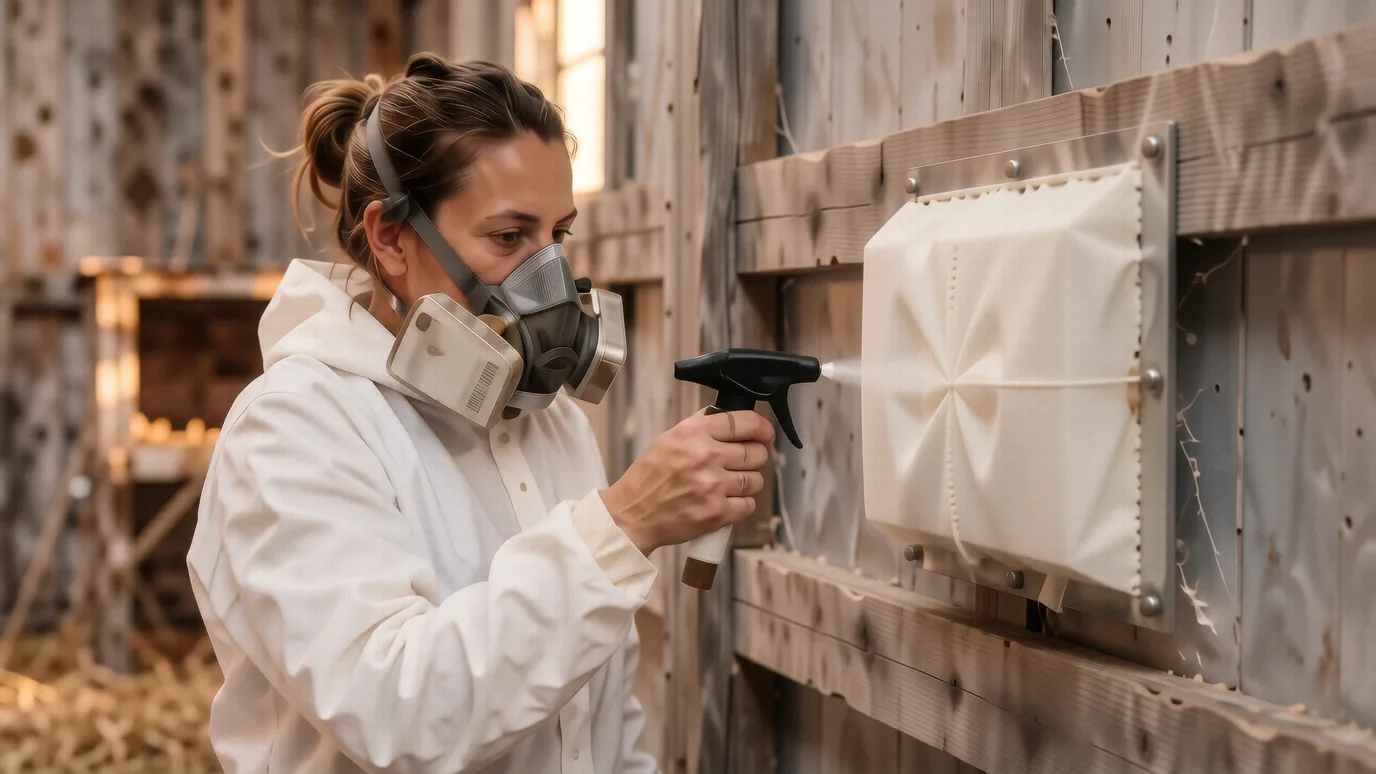
The Hidden Cost of Air Leaks in Breeder Houses
Leaky breeder houses lose more than just heat. Every draft through a wall cavity or floor crack provides a direct highway for pathogens and pests to enter your flock. When you manage primary breeders, air infiltration becomes a biosecurity failure rather than just an energy problem.
Standard insulation often fails because it lacks the density to stop moving air. You might see high utility bills, but the real risk lies in the microscopic entry points that bypass traditional fiberglass or standard spray foam.
Biosecurity Risks Beyond Temperature Control
Primary breeder biosecurity starts with the building envelope. A single gap in a wall panel allows darkling beetles to migrate from the foundation into the nesting area. In 2005, a University of Georgia newsletter documented how these pests use tiny structural voids to bypass standard sanitation protocols.
Pests carry more than just irritation. They act as vectors for disease that can devastate a breeding population before you even spot the first clinical sign. If your sealant cannot stop a beetle, it likely won’t stop airborne pathogens or fine dust particles.
Effective sealing requires high-density materials. AireBarrier Black/White provides a physical barrier that remains stable under pressure. We use this to close the gaps that traditional methods miss.
The Energy and Welfare Connection
Temperature fluctuations stress breeder hens. When cold air drafts hit the birds during winter, their metabolic rate increases to maintain body heat. This diverts energy away from egg production and shell quality.
An Auburn University study validated that sealing broiler barns with AireBarrier resulted in 25-40% energy savings. While breeders have different ventilation requirements than broilers, the physics of air infiltration remains identical. Stable temperatures lead to consistent performance.
Consistent climate control improves animal welfare. Birds spend less energy fighting drafts and more energy on biological output. This stability is measurable in your bottom line.
Recommended Solution: AireBarrier and Soy Bio Sealant
We do not recommend thin coatings for primary breeder applications. You need a material that fills the void completely. Our patented chemistry is designed specifically for these high-stakes environments.
AireBarrier yields approximately 16 board-feet per gallon at a 1-inch thickness. This density is critical because it creates a monolithic seal. Unlike many competing polyurethane products, our Auburn-tested density sits at roughly 1.5 lb/ft³.
For areas requiring food-grade safety or specific environmental profiles, Soy Bio Sealant offers an alternative. Both products focus on stopping air movement rather than just adding R-value. Air movement is the enemy of biosecurity.
Application Methods for Large Scale Facilities
Applying sealant to a massive breeder house requires specialized equipment. Hand-spraying with cans is fine for small repairs, but it won’t work for an entire facility. A single 24 oz can only covers about 3,000 linear feet of a 1/4” bead.
For professional installations, we utilize the SprayPod 2.0. This portable system allows contractors to apply consistent, high-density layers across large surface areas without the downtime associated with heavy machinery. It makes the job efficient.
- Surface Prep: Clean all dust and debris from joints.
- Injection: Use the SprayPod to fill deep cavities.
- Surface Seal: Apply a continuous bead over visible seams.
The 16 lb canister used in our systems is equivalent to roughly ten of the standard 24 oz cans. This scale allows for rapid deployment across long wall runs. Speed matters during downtime between flocks.
ROI and Financial Incentives
Calculating return on investment involves more than just looking at your electric bill. You must factor in bird health, egg quality, and potential disease outbreaks. A single biosecurity breach can cost more than the entire sealing project.
Energy savings are a secondary, but highly predictable, benefit. Many producers qualify for the USDA REAP grant, which offers up to 50% cost-share for energy efficiency improvements. You should watch the application windows closely: March 31, June 30, and September 30.
| State | Estimated Energy Savings | Primary Benefit Focus |
|---|---|---|
| Georgia | 28% | Humidity & Pest Control |
| Arkansas | 34% | Heat Load Reduction |
| North Carolina | 31% | Consistent Egg Production |
These numbers are based on typical breeder house profiles. Actual savings depend on your current building condition and local climate. Always verify your eligibility for federal grants before starting a project.
Common Mistakes in Breeder Sealing
Many contractors attempt to use standard expanding foams to seal large cracks. These foams are often too low-density to stop air long-term. They can shrink or crack as the building settles, reopening the very gaps you tried to close.
Another mistake is ignoring the floor-to-wall transition. This area is a primary entry point for pests and moisture. If you only seal the ceiling and walls, you leave a massive vulnerability at the foundation level.
Don’t forget about electrical penetrations. Every wire running through a wall is a potential path for insects or drafts. Use high-density sealant around every conduit and junction box.
What to Ask When Requesting a Quote
Not all insulation quotes are equal. Some contractors provide a price for “insulation,” which might just mean blowing in more cellulose. That will not improve your biosecurity.
Ask these specific questions:
- “What is the tested density of the sealant you are using?”
- “Does the product meet ASTM E-84 fire testing standards?” (Ag-Tite is the only agricultural sealant to pass this).
- “Can you provide data on air infiltration reduction, not just R-value?”
- “Do you have experience with large-scale breeder house ventilation requirements?”
If they cannot answer these questions, they are likely selling a commodity rather than a solution. You need a technical partner who understands poultry environments.
Check our technical specifications to compare products before you call a contractor. Proper planning prevents wasted capital.
FAQ
Does sealing the house affect ventilation rates?
Yes, but in a controlled way. Sealing stops uncontrolled air infiltration through cracks and voids. It does not block your engineered ventilation system. By eliminating leaks, your fans work more efficiently to move the air you actually want moving.
Is the sealant safe for use around birds?
We prioritize safety in our chemistry. Our products are designed for agricultural environments where biological integrity is paramount. Always consult the specific technical data sheet for the product being used in your facility.
How long does the application take?
The timeline depends on the square footage and the condition of the building. Using equipment like the SprayPod 2.0 significantly reduces installation time compared to manual methods. Most large houses can be treated during standard downtime between flocks.
Can I apply this myself?
While small repairs can be done with 24 oz cans, full-scale biosecurity sealing requires professional equipment. For consistent density and coverage, we recommend using a SprayPod system or hiring an authorized contractor.