Swine Confinement Finishing Barn Insulation
Finishing barns face a constant battle against thermal loss and pest intrusion. Large ventilation requirements often create massive air exchange rates that strip heat
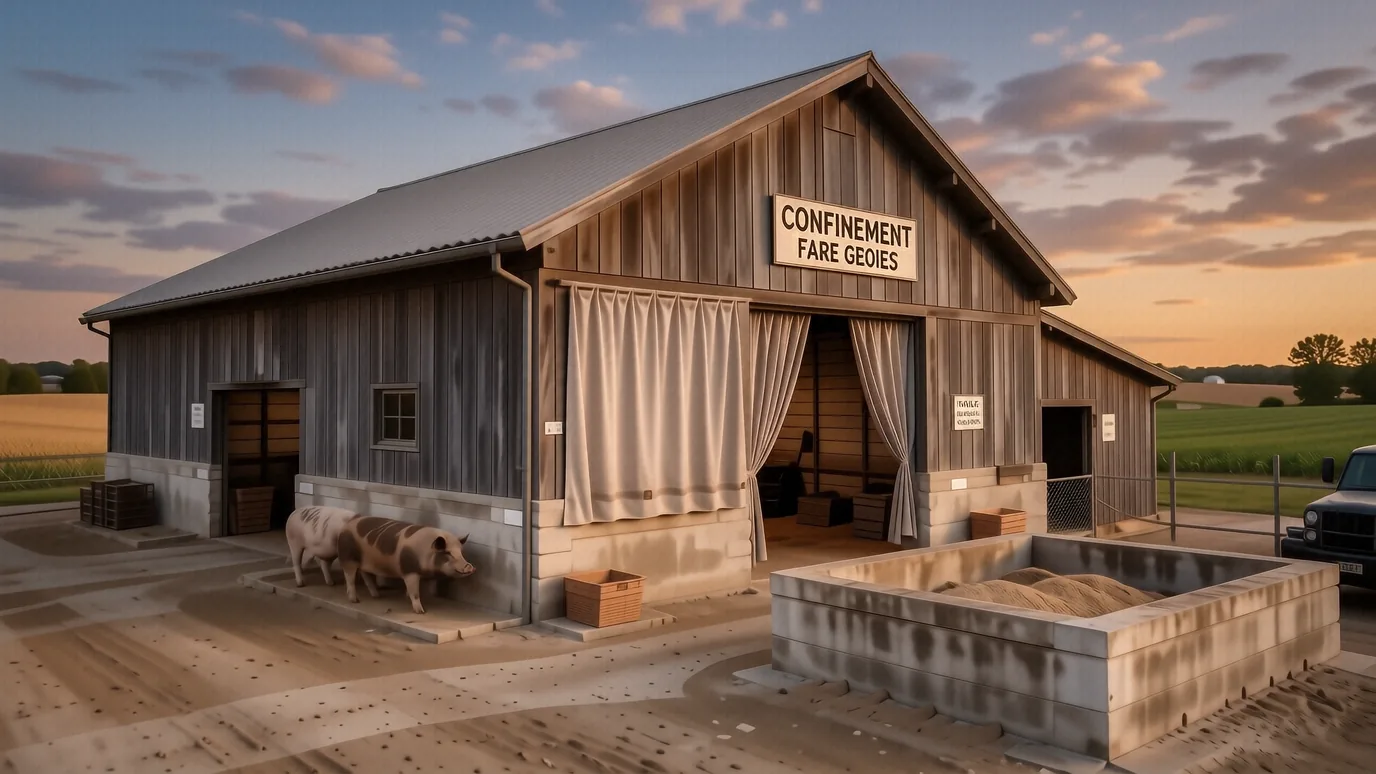
The High Cost of Air Leaks in Finishing Barns
Finishing barns face a constant battle against thermal loss and pest intrusion. Large ventilation requirements often create massive air exchange rates that strip heat from the building during winter months. This inefficiency forces heaters to run longer cycles, which drives up utility bills and creates uneven temperature zones across the pens.
Airflow is your enemy. When warm air escapes through cracks in wall panels or ceiling joints, you lose money immediately.
Effective hog barn insulation must do more than just trap heat; it has to seal the building envelope against drafts and pests. Standard fiberglass batts often fail here because they compress under moisture or allow air to bypass them entirely. A true air barrier stops the movement of air, which is the primary driver of energy loss in swine facilities.
Challenges in Swine Finishing Operations
Temperature stability is critical for finishing hogs. If a barn experiences rapid temperature swings, animal growth rates can stall as pigs divert energy from weight gain to thermoregulation. Fluctuating temperatures also increase humidity levels, which creates a breeding ground for respiratory issues and pathogens.
Biosecurity remains another massive hurdle. In a November 2005 University of Georgia newsletter, researchers demonstrated how darkling beetles penetrate even well-maintained structures through tiny gaps in the building envelope. These pests carry diseases that can devastate an entire herd.
Standard insulation does not stop bugs. You need a physical seal that closes every gap where a beetle or mite might crawl through.
The Ag-Tite Solution: AireBarrier Black and White
We recommend using AireBarrier to address these specific finishing barn challenges. Unlike traditional foam that expands blindly, our patented chemistry is designed to act as a dedicated air barrier. It fills the voids in wall cavities and seals the seams between panels where drafts enter.
The product is dense. Auburn University testing showed an applied density of approximately 1.5 lb/ft³, which is twice the density of many competing polyurethane products on the market. This density helps maintain structural integrity and provides a more consistent thermal seal.
One gallon of AireBarrier yields roughly 16 board-feet at a 1-inch thickness. For smaller repairs or localized sealing around feeder lines, our 24 oz cans provide about 3,000 linear feet of a 1/4” bead.
Application Methods for Maximum Seal
Contractors typically use the SprayPod 2.0 equipment for large finishing barns. This portable system allows for efficient coverage across long spans of wall and ceiling panels. Because the application is controlled, you avoid the massive waste common with high-expansion spray foams.
Precision matters. You must ensure the sealant reaches the junctions where the walls meet the floor and the ceiling meets the roofline. These are the primary entry points for both cold air and pests.
For smaller facilities or localized maintenance, a 16 lb canister is equivalent to roughly ten of our 24 oz cans. This makes it easy to switch between large-scale spraying and detailed bead work around doors or vents.
ROI and Energy Savings Realities
Energy savings vary by climate and existing building condition. However, the Auburn University study on broiler barns—which shares similar ventilation profiles with swine finishing houses—validated energy savings between 25% and 40% when using AireBarrier. These numbers represent a direct reduction in heating costs.
Payback periods depend on your local utility rates. In high-cost heating regions, the ROI often manifests within two to three seasons.
| Region | Estimated Heating Savings | Primary Benefit |
|---|---|---|
| Upper Midwest | 32% - 40% | Reduced propane/natural gas load |
| Southeast | 25% - 30% | Improved humidity control |
| Central Plains | 28% - 35% | Windbreak effectiveness |
You should also consider the USDA REAP grant program. This federal initiative offers up to 50% cost-share for energy efficiency improvements in agricultural buildings. Application windows typically close on March 31, June 30, and September 30.
Common Mistakes in Barn Insulation
Many producers try to save money by using cheap fiberglass or loose-fill cellulose. These materials are highly susceptible to moisture damage in the high-humidity environment of a swine barn. Once they get wet, they lose their R-value and can even promote mold growth.
Don’t ignore the gaps. Many installers focus on the large wall cavities but neglect the small cracks around electrical conduits or plumbing penetrations.
Another mistake is choosing a product that isn’t fire-rated for agricultural use. Ag-Tite is the only agricultural sealant tested to meet ASTM E-84 standards. This provides an essential layer of safety in buildings filled with organic dust and bedding.
What to Ask When Requesting a Quote
Do not accept a quote based solely on square footage. A professional contractor should inspect your building’s specific leak points before providing a final number. You need to know exactly how they plan to handle the junctions between different building materials.
Ask these three questions:
- “What is the tested density of the sealant you are using?”
- “Does the product meet ASTM E-84 fire testing standards for agricultural use?”
- “How will you ensure a continuous seal around ventilation inlets and electrical penetrations?”
If they cannot answer these, they are likely selling you standard foam rather than a true air barrier.
Check your existing Soy Bio Sealant compatibility if you are performing repairs on older installations to ensure long-term adhesion.
FAQ
How much does AireBarrier cover?
One gallon of AireBarrier yields approximately 16 board-feet at a 1-inch thickness. For detail work, a 24 oz can covers about 3,000 linear feet with a 1/4” bead.
Can this help with biosecurity?
Yes. By sealing the microscopic gaps in wall panels and joints, you prevent pests like darkling beetles from entering the barn. This was demonstrated in testing conducted by the University of Georgia.
Is the product fire-safe for barns?
Ag-Tite is the only agricultural sealant tested to meet ASTM E-84 standards. This makes it a safer choice for environments containing combustible organic dust.
How can I fund this project?
The USDA REAP grant provides up to 50% cost-share for energy efficiency upgrades. Be sure to apply during the official windows: March 31, June 30, or September 30.