Closed-Cell vs Open-Cell Spray Foam for Farm Buildings
Drafty poultry houses and uninsulated machine sheds waste money every hour. Most producers assume any spray foam will solve the problem.
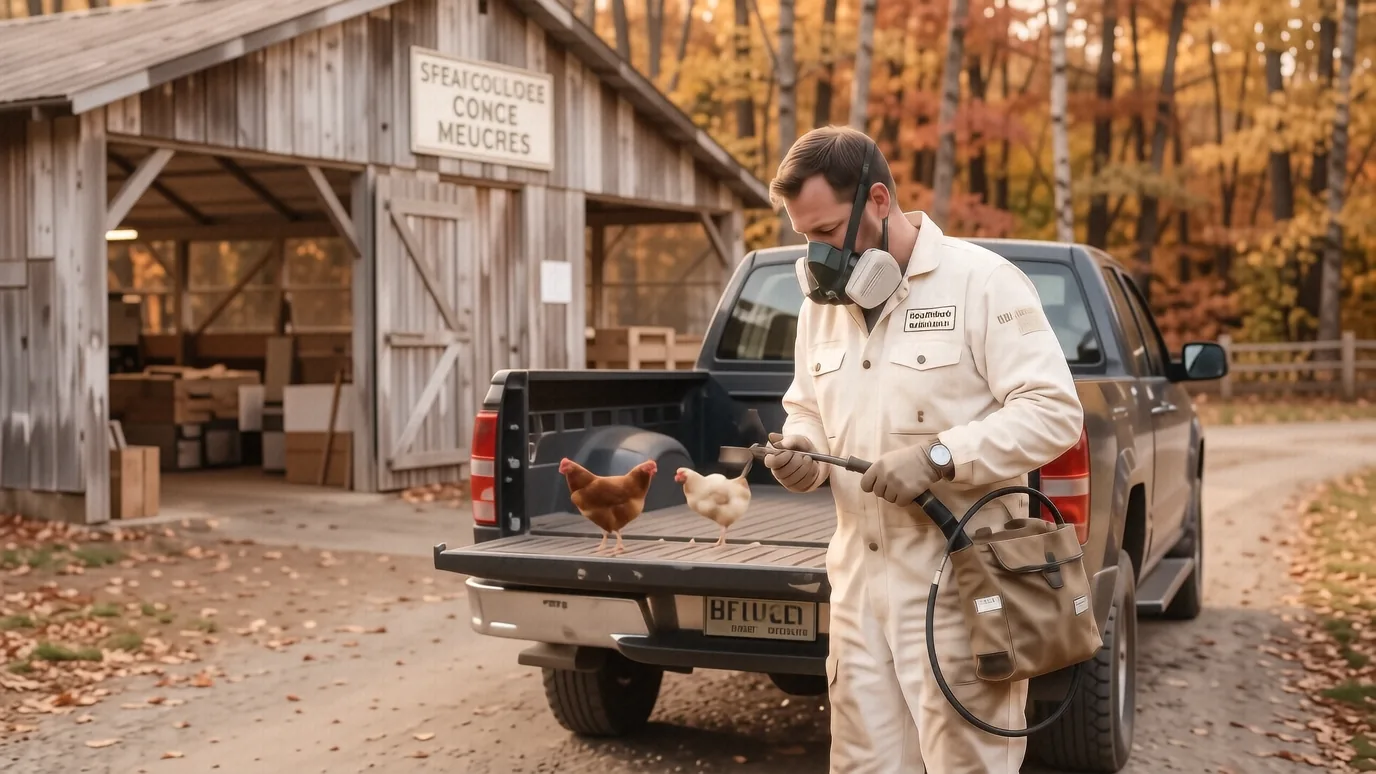
Stop Losing Heat Through Your Building Envelope
Drafty poultry houses and uninsulated machine sheds waste money every hour. Most producers assume any spray foam will solve the problem. This is a mistake because open-cell and closed-cell foams behave differently under agricultural stress. Choosing the wrong type leads to structural rot or wasted energy.
You need to understand the physics of your building before you buy material.
The Technical Breakdown: Closed-Cell vs Open-Cell Foam
Closed-cell foam consists of tightly packed cells that do not allow air or moisture to pass through easily. It acts as both an insulator and a vapor barrier. This density makes it much harder to compress.
Open-cell foam has a structure similar to a sponge. The cells remain open, allowing air to move through the material. It provides excellent thermal resistance but lacks the structural strength of its closed-cell counterpart.
| Feature | Closed-Cell Foam | Open-Cell Foam |
|---|---|---|
| R-Value per inch | ~6.5 to 7.0 | ~3.5 to 3.8 |
| Vapor Permeability | Very Low (Barrier) | High (Permeable) |
| Density | ~2.0 lb/ft³ or higher | < 0.5 lb/ft³ |
| Structural Support | Adds rigidity to walls | Minimal structural impact |
| Moisture Resistance | Excellent | Low |
| Typical Cost | Higher per board-foot | Lower per board-foot |
Density matters in a barn. Auburn University testing showed that Ag-Tite products reach ~1.5 lb/ft³, which is twice the density of many competing polyurethane products. This density prevents the “crushing” effect often seen in cheap open-cell applications.
When Closed-Cell Foam Wins
Closed-cell foam is the standard for high-moisture environments. If you are sealing a broiler barn or a wash bay, you need this density. It stops the movement of humid air through the wall cavity.
The Auburn study validated that properly sealed barns see energy savings between 25% and 40%. This level of efficiency requires a complete airtight seal. Closed-cell foam provides that seal because it does not allow convective loops within the foam itself.
It also serves as a secondary structural component. In metal buildings, closed-cell foam can help stiffen thin-gauge steel panels. It resists the pressure of wind loads better than lighter foams.
When Open-Cell Foam Wins
Open-cell foam works well in controlled environments like finished offices or dry storage. It is much cheaper to apply over large surface areas. If your primary goal is sound dampening in a dry tack room, open-cell is an option.
However, it fails in most poultry and swine applications. Because it is permeable, moisture can migrate through the foam. This often leads to condensation on the backside of your metal skin. Once water gets trapped, rot begins.
The Hidden Risks of Open-Cell in Agriculture
Moisture management is the biggest hurdle for rural contractors. A 2005 University of Georgia newsletter highlighted how darkling beetles use tiny gaps to penetrate structures. While foam helps, open-cell foam can sometimes act as a bridge for moisture if not installed perfectly.
If you choose an open-cell product in a high-humidity area, you risk “wetting out” the insulation. This destroys the R-value and creates a breeding ground for mold.
Always consider your AireBarrier application needs before selecting a cell type. A true air barrier must be non-permeable to prevent heat loss via convection.
Real Cost Numbers and ROI
Price per board-foot is the most common metric used by contractors. Closed-cell foam typically costs significantly more than open-cell. You might pay $0.85 to $1.25 per board-foot for closed-cell, whereas open-cell might sit at $0.40 to $0.60.
Do not look only at the upfront cost. Look at the lifecycle of the building.
A broiler barn using Soy Bio Sealant or AireBarrier can recoup the higher installation cost through reduced heating and cooling bills. If your energy savings are 25% to 40%, the math usually favors the denser, more expensive product over a five-year period.
Decision Framework for Producers
Ask yourself these three questions before signing a contract:
- Is there high humidity or animal respiration? If yes, use closed-cell.
- Am I sealing against pests? Closed-cell provides a much tighter physical barrier.
- What is the structural integrity of my skin? Use closed-cell to reinforce thin metal.
If you are working on an older building with existing leaks, focus on sealant technologies that address air infiltration specifically rather than just adding bulk insulation.
Why Ag-Tite Chemistry Differs
Most commercial spray foams are designed for residential comfort, not agricultural survival. They often fail the rigorous demands of a working farm. Our AireBarrier Black and White products are engineered for durability.
We are the only agricultural sealant tested to ASTM E-84 fire standards. This is a critical distinction when dealing with high-dust environments like feed rooms or hay storage.
The SprayPod 2.0 equipment allows for precise application of these dense chemistries. Precision prevents the waste common with large, unmanaged foam rigs.
Calculating Your Coverage Needs
Estimating material is vital for project budgeting. A standard 24 oz can provides approximately 3,000 linear feet of a 1/4” bead. If you are using larger canisters, a 16 lb canister is roughly equivalent to ten of those 24 oz cans.
For large-scale wall spraying, remember that AireBarrier yields about 16 board-feet per gallon at a 1” thickness. Use these numbers to verify your contractor’s quote. If their math seems off, they may be underestimating the material needed for a full seal.
Maximizing Your Investment with USDA REAP
You should not pay full price for high-performance insulation. The USDA Rural Energy for America Program (REAP) offers cost-share opportunities. You can receive up to 50% of your project costs covered through these grants.
Application windows typically close on March 31, June 30, and September 30. Plan your insulation upgrades well in advance of these dates. A denser closed-cell application often qualifies more easily because the energy savings are easier to document via studies like the Auburn research.
Check your local USDA service center to start the paperwork.
FAQ
Which foam is better for poultry houses?
Closed-cell foam is superior for poultry houses. It provides a much tighter air seal and resists moisture penetration from animal respiration. This prevents condensation and helps maintain the 25-40% energy savings seen in Auburn University studies.
Can I use open-cell foam on metal buildings?
It is generally not recommended for agricultural metal buildings. Open-cell foam is too permeable, which allows moisture to move through the insulation and condense against the metal skin. This often leads to rust and structural degradation.
How much can I save with REAP grants?
The USDA REAP program can cover up to 50% of your total project costs. You must apply during specific windows: March 31, June 30, or September 30.
Is spray foam fire-safe for farms?
Not all foams are equal. Ag-Tite is the only agricultural sealant tested to meet ASTM E-84 standards. Always ask your contractor for specific fire-test documentation before they begin spraying in high-dust areas.