Foam Vs. Sealants. Which one wins?
Most farmers approach building envelope issues looking for insulation. They want to keep the heat in or the cool air out.
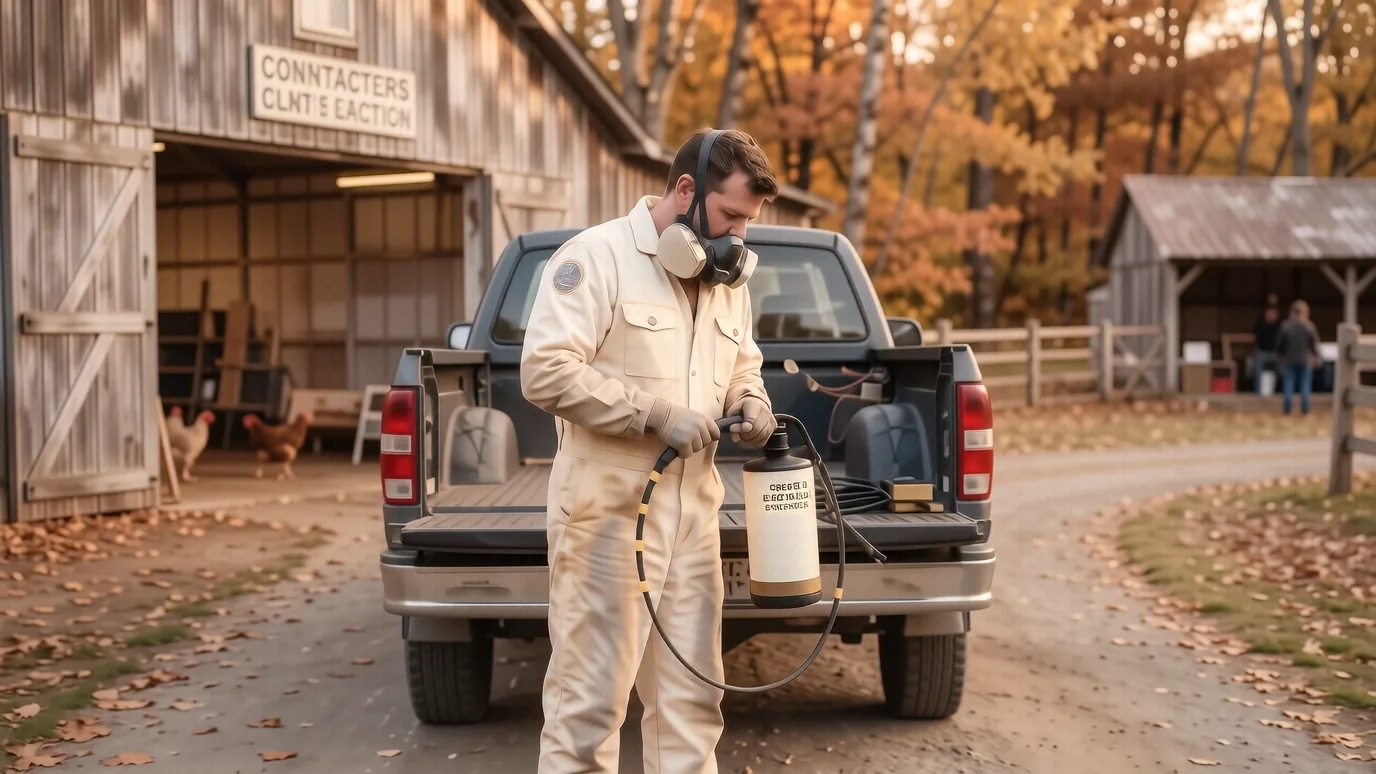
The Failure of Spray Foam in Agricultural Environments
Most farmers approach building envelope issues looking for insulation. They want to keep the heat in or the cool air out. However, in large-scale poultry or livestock operations, the primary enemy is not temperature loss; it is uncontrolled airflow. When a building leaks air, your ventilation system works harder, your energy bills climb, and your production environment becomes unstable.
Many contractors suggest spray foam as a quick fix for these leaks. They promise a seamless barrier that stops drafts instantly. In reality, standard residential or commercial foams often fail in agricultural settings in less than 24 months. This failure is not due to poor application alone, but because the chemistry of standard foam is fundamentally mismatched with the rigors of a working farm.
The High Cost of Short-Term Solutions
In 2007, one farmer invested $7,850 per house to seal sidewalls using 1.9 lb/ft³ closed-cell foam at a 2-inch thickness. This application targeted the curtain openings and wall joints to stabilize the environment. Despite the significant upfront cost, the foam failed to provide long-term protection.
Foam can work well in rooflines or ridgecaps where it remains protected from direct contact. It struggles significantly in sidewalls. These areas are constantly exposed to moisture, heavy equipment, insect pressure, and high-pressure washing. When a product is not designed for these specific stressors, the investment disappears almost as quickly as it was applied.
The goal of any sealing project should be to maintain static pressure and ventilation characteristics. If the building envelope is compromised, you lose control over your climate. This leads to inefficiencies that impact more than just your electric bill; they affect feed conversion rates and overall bird health.
Why Standard Foam Fails on the Farm
To understand why foam fails, we must look at how these products are categorized. Most contractors offer two types: Open Cell (approximately 0.5 lb/ft³) and Closed Cell (1.7 to 2.0 lb/ft³). Neither is truly designed for the agricultural lifecycle.
Lack of Surface Durability
It is nearly impossible to spray foam insulation and achieve a smooth, hard surface. Foam naturally leaves ridges, seams, and pits. These imperfections are more than just cosmetic issues. They create entry points for pests. A 2005 U Georgia newsletter highlighted how darkling beetles use these small crevices to penetrate building materials. Once insects find a way into the material, they can compromise the entire seal.
Adhesion Challenges
Agricultural buildings are composed of dissimilar materials. You have wood, OSB, concrete, plastic, and steel all meeting in a single corner. Foam often struggles to bond to these varied surfaces over time. If the adhesion rate is low, the product will eventually peel or pull away from the substrate as the building moves and racks.
The “Skin” Problem
Most open and closed-cell foams have an extremely thin outer skin once cured. In many cases, you can poke a finger right through it. This skin is your only line of defense. When a farmer uses a high-pressure washer to clean a house, that pressure easily punctures the foam skin. Once the internal structure is exposed to moisture and biology, the degradation accelerates rapidly.
Improper Chemistry
Many contractors attempt to color their foam by mixing in black or white paint. This is a mistake. Adding external paint to polyurethane chemistry often breaks down the structural integrity of the foam itself. True agricultural sealants use specialized colorants integrated directly into the chemical reaction to ensure the color remains stable without compromising the bond.
The Ag-Tite Difference: Sealing vs. Insulating
Since 2005, Sealant Technologies has focused on a different philosophy. We do not focus on adding bulk insulation; we focus on creating an airtight seal. This distinction is vital for poultry broiler barns. When you prioritize sealing, you achieve much higher durability.
Our approach relies on the patented Ag-Tite chemistry, which differs from standard foam in several technical ways:
- High Density: While common foams hover around 2.0 lb/ft³, our sealants are designed with heavy density chemistry, often exceeding 3.0 lb/ft³.
- Hardness and Flexibility: A successful sealant must be hard enough to resist puncture but flexible enough to move with the building’s natural racking.
- Integrated Colorants: We use colorants within the chemistry of AireBarrier Black and AireBarrier White so the product does not degrade over time.
- Superior Adhesion: Our products are engineered to stick to difficult surfaces like concrete, which is a common failure point for standard foams.
The results of this method are backed by data. An Auburn University study validated that sealing broiler barns with AireBarrier resulted in 25-40% energy savings. This proves that airtightness provides a better return on investment than mere insulation thickness.
Implementing the Right Technology
Success in the field requires more than just the right product; it requires the right application method. Using a single product for every part of a building is like trying to use a square peg in a round hole. A professional installation uses different sealants for different zones within the house.
For large-scale projects, efficiency is key. We developed the SprayPod 2.0 to allow for precise, portable application that meets the specific needs of agricultural structures. This equipment ensures that the sealant is applied according to the unique requirements of the farm, rather than the standard residential protocols used by general contractors.
If you are looking to upgrade your facility, you should also consider how to fund these improvements. The USDA REAP grant can provide up to 50% cost-share for energy efficiency projects. You can use our REAP grant estimator to see if your project qualifies.
Frequently Asked Questions
How much energy can I actually save by sealing my barn?
According to an Auburn University study, broiler barns sealed with AireBarrier experienced energy savings between 25% and 40%. These savings come from improved ventilation control and reduced heater/cooler run times.
Can I use regular spray foam for my sidewalls?
We generally advise against it. Standard residential foams lack the density and skin thickness required to withstand high-pressure washing, insect penetration, and the constant movement of agricultural buildings.
What is the difference between AireBarrier and standard insulation?
Insulation is designed to slow heat transfer through a material. A sealant like AireBarrier is designed to stop the actual movement of air and moisture. In large ag buildings, stopping air leaks provides more immediate economic benefits than adding thickness to your insulation.
Does Ag-Tite work on concrete surfaces?
Yes. One of the primary advantages of our patented chemistry is its high adhesion rate on difficult substrates, including concrete, wood, and metal.
How do I know if my project qualifies for a USDA grant?
The USDA REAP program offers cost-sharing for energy efficiency upgrades. Application windows typically close on March 31, June 30, and September 30. You can check our REAP grant resources for more details.
To see how much your facility could save, use our ROI Calculator.
Authoritative sources
- ASTM E84 — Standard Test Method for Surface Burning Characteristics
- EPA — Spray Polyurethane Foam guidance